THE COLOR NOTEBOOK / THE BASICS
How to Play a Cartoon Color Guessing Game
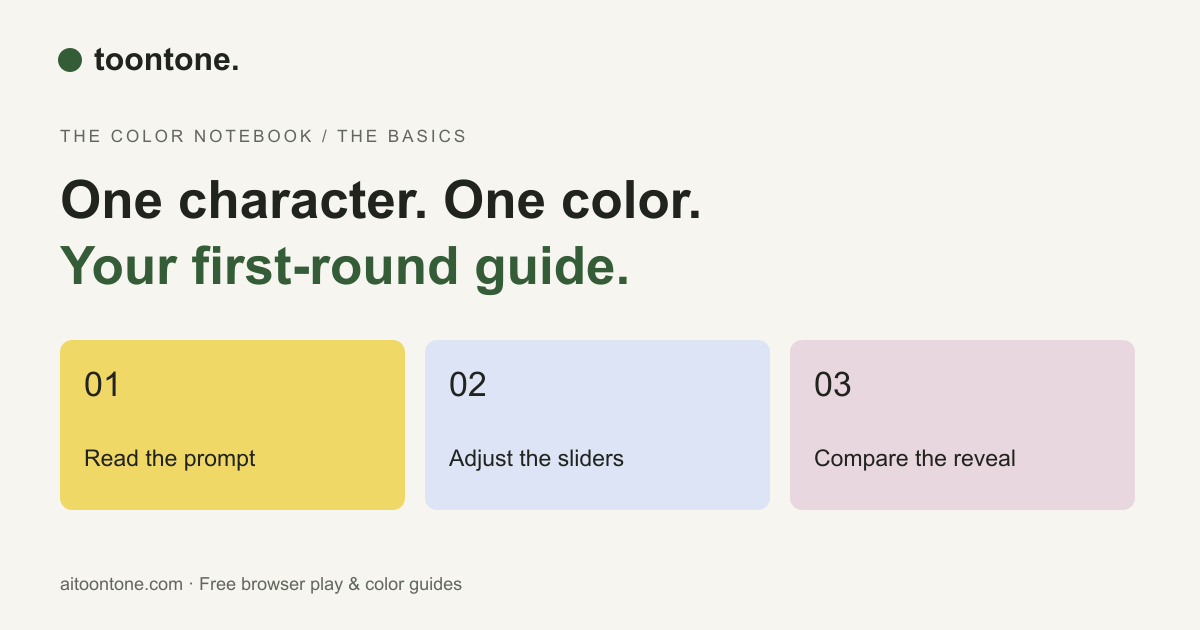
Recognizing a cartoon character is easy. Rebuilding one small patch of their color from memory is a different challenge.
In a cartoon color guessing game, the prompt names a character and a particular part to match. You create your guess with color sliders, then submit it to see how closely it matches the target. The useful question after each round is not just “What did I score?” but “Which part of my guess was off?”
1. Read the whole prompt
Identify the exact part being requested before touching a slider. A character can have a yellow face, a cream shirt, and a gold accessory. Remembering the general palette is helpful, but the target is one specific color. If the character has several appearances, the version shown in the game matters more than a different image you remember.
2. Start with a color family
Use hue to choose the broad family: red, orange, yellow, green, blue, or purple. At this stage, aim for “a yellow leaning toward orange” rather than a precise numeric value. Once the family looks plausible, leave hue alone while you test the other controls.
3. Adjust intensity, then brightness
Saturation changes how vivid a color looks. A low-saturation blue can look grayish; a high-saturation blue looks stronger. Brightness in HSB changes the value from black toward the chosen color. Some games use lightness instead, which behaves differently. Follow the game's control labels rather than assuming every slider uses the same model.
4. Submit and study the reveal
When the target appears beside your guess, describe one difference in words. For example: “My blue was too purple,” or “My yellow was too dark.” That gives the next round a specific lesson. Moving all the sliders at once makes it harder to tell which change helped.
5. Make a small practice routine
Try one round without rushing, compare the two colors, then take a short break before another attempt. Our daily practice provides five simple swatches without requiring any character knowledge. It uses its own scoring system, so compare results within that exercise rather than against the embedded game's scores.
Ready for your first round?