THE COLOR NOTEBOOK / BETTER PRACTICE
Six Practical Tips for Color Memory Games
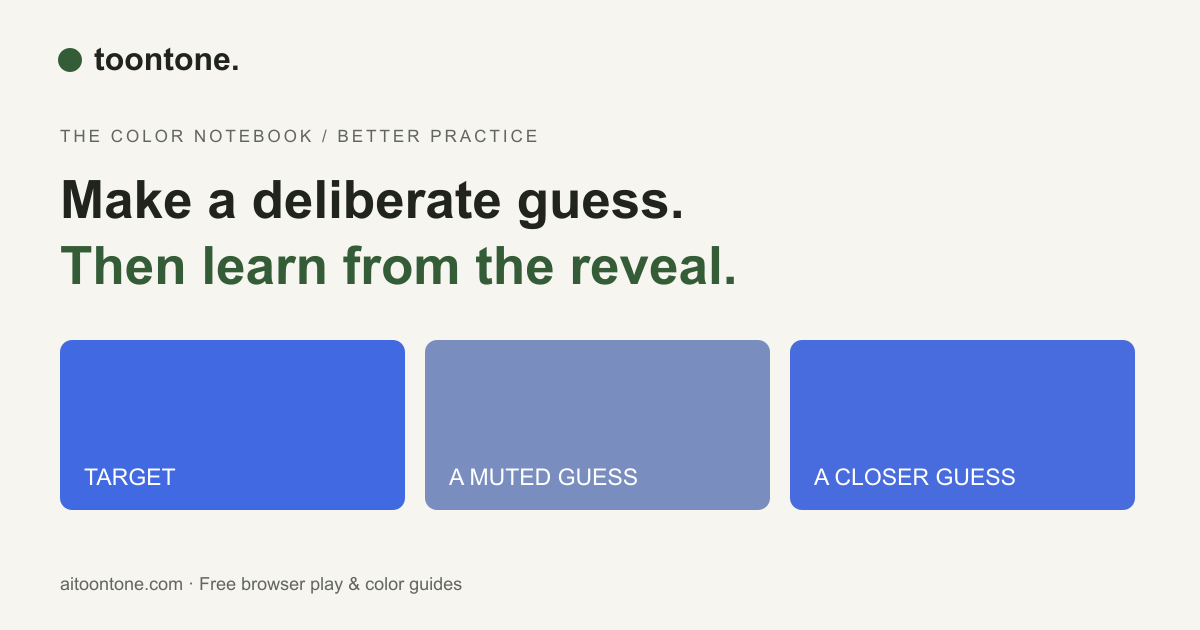
A consistent routine gives you something useful to learn from each round, even when your guess is far from the target.
Color guessing combines memory with a new visual judgment: you remember a shade, then decide whether the swatch on screen feels like it. You cannot control every part of that process. You can control how you make adjustments and review the result.
1. Name the specific target
Before moving a slider, say what you are matching: “the hat's warm red,” rather than “the character's red.” This keeps a related color from another part of the design from becoming your reference. In swatch practice, give the color a short descriptive label such as “muted green.”
2. Choose the family before the finish
Begin with hue. A slightly imperfect green in the correct family gives you a clearer starting point than a very carefully tuned blue. Leave fine adjustments until the broad direction seems right.
3. Move one slider at a time
If the color looks washed out, try saturation before changing hue and brightness together. Pause after an adjustment and look again. A single change is easier to evaluate and easier to reverse if it moves away from your intended shade.
4. Compare the reveal with a question
When you see the target, ask one specific question: was your guess too light, too vivid, or too close to a neighboring hue? A score tells you how the game rated the result. A description tells you what you might change next time. Our practice score uses simple RGB distance, so treat it as feedback within the exercise rather than a perceptual measurement.
5. Keep viewing conditions consistent
Try your next session on the same device with similar screen settings. Night modes, changing screen brightness, and sunlight can make comparisons across sessions less meaningful. You do not need a calibrated monitor to enjoy the game; consistency simply makes your own results easier to interpret.
6. Replay with a purpose
Our daily practice repeats the same five targets for the UTC date. A second run lets you check a specific observation from the first: for example, whether you were making dark shades too bright. A higher score after repeated exposure is a practice result, not proof of better performance on unseen colors.
What to try in your next session
Choose just one of these habits. Finish five rounds, then write down the most common mismatch you noticed. On the next run, pay attention to that one pattern. Keep the exercise playful: the goal is a more intentional guess, not a promise of a perfect score.